Saturday, May 13, 2017

The Church and science, Part 4

So far in this series, we have been discussing science; how the Church views it, some of the key Catholic figures and moments in the history of science, and some evidence from the contemporary scene that the Church values and thinks highly of science.

Just why does the Church think highly of science?  Simply put, it is because the Church values reason. When one looks up the different definitions of science, the idea of it being a systematic study, or a systematic organization of knowledge come up.  For a system to work, it must be reasonable, or it will not function.  This is why the Church values science, because it is reasonable.  (Now there may be cases here and there where those practice or advocate something in the scientific field may not act or think reasonably, but I think all in the sciences would agree that should be the exception, and not the norm.)

Before we continue, I should point out here that for the purposes of this series, we have been referring to kind of a limited definition of science, namely the physical and natural sciences, those branches of study that focus on the natural world; the human body, the environment, animals, suns, the planet, etc.   However, in reality, there are other types of sciences besides the natural sciences, but we don’t typically think that way in our modern world.   There is the science of philosophy, which is the study of knowledge, reality, and existence in general.  There is the science of theology, which is the study of the nature of God.   These, however, can be considered science because they are indeed systematic, just like any good natural science is.   They have building blocks, and logically move from one level of discovery and truth to another, just like good natural science does.  However, we will continue, for our purposes here, to continue to imply the natural sciences when we speak of science.

So the Church values science because it is reasonable.  Why does the Church value reason?  In paragraph 159 of the Catechism, we read the following about the relationship between faith, reason, and science, "Though faith is above reason, there can never be any real discrepancy between faith and reason. Since the same God who reveals mysteries and infuses faith has bestowed the light of reason on the human mind, God cannot deny himself, nor can truth ever contradict truth." "Consequently, methodical research in all branches of knowledge, provided it is carried out in a truly scientific manner and does not override moral laws, can never conflict with the faith, because the things of the world and the things of faith derive from the same God. The humble and persevering investigator of the secrets of nature is being led, as it were, by the hand of God in spite of himself, for it is God, the conserver of all things, who made them what they are."  So since God is the author of both the natural and the supernatural world, it stands to reason (no pun intended) that scientific research and theology (the study of revealed truth) would lead to the same end and cause of all things, God.  Therefore, since it leads to God (when done in a morally appropriate way), science is valued by the Church.

The Catechism elaborates on the gift of reason further in paragraph 286.  “Human intelligence is surely already capable of finding a response to the question of origins. The existence of God the Creator can be known with certainty through his works, by the light of human reason, even if this knowledge is often obscured and disfigured by error. This is why faith comes to confirm and enlighten reason in the correct understanding of this truth: "By faith we understand that the world was created by the word of God, so that what is seen was made out of things which do not appear."   Faith can give us things that go beyond reason, such as the mystery of the Trinity (the second person of which was alluded to in the quote above, the word of God (Jesus, the Son of God).   However, faith will never reveal anything that goes against reason.  If faith were unreasonable, it would not be worthy of the supernatural gift of God that it is.  (For a refresher on the gift of faith, please see my post on it that I did on June 26 of last year,  http://jimscatholicblog.blogspot.com/2016/06/faith.html).

Saint John Paul II wrote a beautiful (although dense and heavy at times) encyclical on the relationship between faith and reason in 1998 entitled Fides et Ratio (Faith and Reason).  While this encyclical deals mostly with philosophy and theology, it does have a few things to say about science.   In one of its closing paragraphs, the Holy Father has this to say to scientists:  Finally, I cannot fail to address a word to scientists, whose research offers an ever greater knowledge of the universe as a whole and of the incredibly rich array of its component parts, animate and inanimate, with their complex atomic and molecular structures. So far has science come, especially in this century, that its achievements never cease to amaze us. In expressing my admiration and in offering encouragement to these brave pioneers of scientific research, to whom humanity owes so much of its current development, I would urge them to continue their efforts without ever abandoning the sapiential horizon within which scientific and technological achievements are wedded to the philosophical and ethical values which are the distinctive and indelible mark of the human person. Scientists are well aware that “the search for truth, even when it concerns a finite reality of the world or of man, is never-ending, but always points beyond to something higher than the immediate object of study, to the questions which give access to Mystery”  The Holy Father calls for science never to be an end in its own, but it must be at the service of man, something we have noted before.   It must be in communication with other forms of study; philosophy, morality, and theology most noteworthy.  I would also add it should be in communication with those who study economics, and sociology.  The world must seek to engage itself with the scientific community, but the scientific community must also realize it is just one cog in the overall breadth of knowledge, and not the end and purpose of all knowledge.

There was one further paragraph in the encyclical which I will note here that alludes to the error of this line of thought.  The Holy Father referred to something called scientism, distinct from scientific inquiry.   This is more a philosophy than a true science, and not a good philosophy at that.  Here is some of what he says about scientism: This is the philosophical notion which refuses to admit the validity of forms of knowledge other than those of the positive sciences; and it relegates religious, theological, ethical and aesthetic knowledge to the realm of mere fantasy…Science would thus be poised to dominate all aspects of human life through technological progress. The undeniable triumphs of scientific research and contemporary technology have helped to propagate a scientistic outlook, which now seems boundless, given its inroads into different cultures and the radical changes it has brought…Regrettably, it must be noted, scientism consigns all that has to do with the question of the meaning of life to the realm of the irrational or imaginary.   What the Holy Father is trying to say is that science, while valuable, has limits in terms of what it can tell us about the meaning and purpose of life, and to get at those areas, we need to go to other forms of knowledge like philosophy and theology.  Lines of thought like scientism, which deny those other areas outside science as valid, must therefore be condemned. 

There is one final quote from John Paul II that I would like to mention and this comes from a message to a 1987 conference held at the aforementioned (last post) Vatican Observatory.  He said,  Science can purify religion from error and superstition; religion can purify science from idolatry and false absolutes. Each can draw the other into a wider world, a world in which both can flourish.  I don't think this quote speaks for itself, and does not needs any further explaining on my part.

Faith and reason work together to bring us to truth.  Since science seeks a reasonable explanation of things, it is of value to the Church, and the Church will never cease to uphold and promote the dignity of science, as long as it is carried out according to moral norms (which we discussed in post one of this series), and does not disengage from other branches of study (as we discussed here).   We have seen the evidence of the Church living out this reality of valuing science in the past (post two of this series), and in the present (post three).

With this post, we have now finished discussing science in general.  In the last two posts in this series, we will move from the general to the specific, and discuss two specific areas today where science and faith intersect that are causing controversy, and that is the topics of the environment, and the theory of evolution. 
Joseph most just, pray for us.
.

Sunday, May 7, 2017

The Church and science, Part 3


In the last post, we discussed some notable people and developments in the history of Church and science.  In this post, we will focus on contemporary evidence of a respectful and fruitful relationship between the Church and science.

First off, there is the existence in Rome of the Pontifical Academy of Sciences.  This was founded in 1936 by Pope Pius XI.   It draws on many of the world's leading scientists, including many Nobel Laureates, to act as advisors to the Popes on scientific issues. The Academy has an international membership which includes British physicist Stephen Hawking. 

Under the protection of the reigning Pope, the aim of the Academy is to promote the progress of the mathematical, physical and natural sciences and the study of related epistemological problems.  The statutes of 1976 express its goal: "The Pontifical Academy of Sciences has as its goal the promotion of the progress of the mathematical, physical, and natural sciences, and the study of related epistemological questions and issues."

The Academy and its membership are not to be influenced by factors of a national, political, or even religious character.  Learned people of good will, regardless of any religious affiliation, are able to be members.  Therefore, it represents a valuable source of objective scientific information which is made available to the Holy See and to the international scientific community.

Today the work of the Academy covers six main areas: fundamental science, the science and technology of global questions and issues, science in favor of the problems of the Third World, the ethics and politics of science, bioethics and epistemology.  The disciplines involved are sub-divided into eight fields: the disciplines of physics and related disciplines; astronomy; chemistry; the earth and environmental sciences; the life sciences (botany, agronomy, zoology, genetics, molecular biology, biochemistry, the neurosciences, surgery); mathematics; the applied sciences; and the philosophy and history of sciences.

Pope John Paul II had this to say about the Academy in 1979.  His words speak to the overall relationship of faith and science.  (I have bolded some of the more noteworthy passages.)

The existence of this Pontifical Academy of Sciences, of which in its ancient ancestry Galileo was a member and of which today eminent scientists are members, without any form of ethnic or religious discrimination, is a visible sign, raised amongst the peoples of the world, of the profound harmony that can exist between the truths of science and the truths of faith.... The Church of Rome together with all the Churches spread throughout the world attributes a great importance to the function of the Pontifical Academy of Sciences. The title of 'Pontifical' given to the Academy means, as you know, the interest and the commitment of the Church, in different forms from the ancient patronage, but no less profound and effective in character.... How could the Church have lacked interest in the most noble of the occupations which are most strictly human – the search for truth?

Both believing scientists and non-believing scientists are involved in deciphering the palimpsest of nature which has been built in a rather complex way, where the traces of the different stages of the long evolution of the world have been covered over and mixed up. The believer, perhaps, has the advantage of knowing that the puzzle has a solution, that the underlying writing is in the final analysis the work of an intelligent being, and that thus the problem posed by nature has been posed to be solved and that its difficulty is without doubt proportionate to the present or future capacity of humanity. This, perhaps, will not give him new resources for the investigation engaged in. But it will contribute to maintaining him in that healthy optimism without which a sustained effort cannot be engaged in for long.


His successor, Pope Benedict XVI, had this to say to the Academy in 2012.  His entire comments are worth highlighting in my opinion!

Dialogue and cooperation between faith and science are urgently needed for building a culture that respects people and the planet... Without faith and science informing each other "the great questions of humanity leave the domain of reason and truth, and are abandoned to the irrational, to myth, or to indifference, with great damage to humanity itself, to world peace and to our ultimate destiny.... (As people strive to) unlock the mysteries of man and the universe, I am convinced of the urgent need for continued dialogue and cooperation between the worlds of science and of faith in building a culture of respect for man, for human dignity and freedom, for the future of our human family and for the long-term sustainable development of our planet.

Another example of the respect the Church has for science is the existence of the Vatican Observatory.   As we mentioned last post, the Church has a long history of interest in astronomy due to the astronomical basis on which the Church calendar is maintained.  This observatory is located 16 miles away from the Vatican, at Castel Gandolfo, where the Papal summer residence is located.  There is also an auxiliary station in Arizona.  Its current director is Brother Guy Consolmagno.  He is known as the “Pope’s astronomer”.  He became the first religious brother to be awarded the American Astronomical Society's Carl Sagan Medal for Excellence in Public Communication in Planetary Science in 2014. The judges described Consolmagno as "the voice of the juxtaposition of planetary science and astronomy with Christian belief, a rational spokesperson who can convey exceptionally well how religion and science can co-exist for believers.”  Consalmagno describes science as an "act of worship ... a way of getting close to creation, to really getting intimate with creation, and it's a way of getting intimate with the creator.”

The final evidence I will offer is all around us at our Catholic schools and universities.   Science is taught at all levels of Catholic education.  It is a requirement at many of her higher level institutions, even for non-majors.  I am sure many of you could name someone you know associated with science who is also a devout believer.  There are a few Catholic science teachers among my Facebook friends, and to you, I say thank you!

Hopefully, these posts so far have shown that the Church is in no way opposed to science. Science, really, should not see the Church or religion in general, as an adversary, and vice versa.  The world works best when there is mutual respect between the two.   Faith and reason must go together; if one or the other is absent, the individual, and therefore the world, is missing something precious.

We discussed in the first post what the Catechism has to say about science. We got a glimpse in this post, when discussing the Papal Academy, some Papal teaching regarding the relationship between faith and science.  In the next post, we will discuss in more detail Papal teaching throughout the years regarding faith, reason, and science.

Tuesday, May 2, 2017

The Church and science, Part 2


Continuing our series of reflections on the Church and science, we will focus this post on some of the history of the Church and science.  

During its earliest days, the persecuted Christian Church was noted for its tending to the sick and infirmed.  Priests were often also physicians.   Early Church fathers like St Benedict of Nursia and Clement of Alexandria emphasized medicine as an aid to the provision of hospitality.

After the fall of Rome, it was the monks who carried on the intellectual tradition of Western civilization.  This included study of the natural world.   There was religious motivation for this; for example, studying the stars and sun to determine times to pray, and when to celebrate certain feasts like Easter.  They also continued the study of medicine. 

This led later on to the establishment of schools and universities.  There were 50 Catholic universities in Europe by the mid-15th century.   Roger Bacon was a Franciscan priest who studied at Oxford, and taught at the University of Paris.  He studied nature, and is considered to be the founder of the scientific method.  Georges Lemaitre was a priest and astronomer was the first to propose what is now known as the Big Bang Theory.   He taught physics at the Catholic University of Louvain.  He applied Einstein’s theory of relativity to cosmology.

Also at this time (the Middle Ages), great cathedrals were being built.  The beauty of these cathedrals was attributed in part to a great understanding of mathematics.     Rene Descartes, in addition to being a philosopher, is also considered the father of modern geometry.

During this time, the study of geology began to take root.   Georgius Agricola, a German catholic and scientist, is known as the father of mineralogy.  (One can see the origin of the word “agriculture” in his last name.)   Nicolas Steno was a Bishop who also studied the formation of rock layers and fossils which are still used today. 

The study of astronomy also owes a lot to the contribution of Catholics.   Based in large part on input from astronomers, at his request, Pope Gregory XIII introduced to the world the Gregorian calendar that is still used throughout the world today for measuring the year.  Nicolas Copernicus was an astronomer and priest was the first person to formulate a comprehensive heliocentric cosmology which displaced the Earth from the center of the universe.   He devoted his work where he explained this theory to Pope Paul III.

Decades after Copernicus, Galileo Galilei, also a Catholic scientist, came along and supported Copernicus’ theory.   He is known as the founder of modern science.  I am sure this name is familiar to most of you because of the controversy of him being condemned by the Church.  One could do an entire post on this case, but for now, suffice to say a few things.  1)  He was originally censured not for his heliocentric views, but rather, for his critical view of Scripture.  2)  He was condemned (incorrectly, yes) for his heliocentric views, after a lengthy review, but his reasons of support for his theory are still questioned today (even though the theory is not). 3) He was not tortured and the conditions of his imprisonment were rather benign. The Church has apologized for giving him a bad name during his time, and rehabilitated his name since then, but everything was not as bad as it is made out to be today.  Galileo never renounced his Catholic faith.

So we see here Catholics with a huge role in the founding of modern medicine, astronomy, geology, and mathematics!  Their schools and monasteries were especially centers for this.

Here are some other notable Catholic figures in the history of science.

Gregor Mendel was an Augustinian monk who discovered the basis for genetics.   Jesuit Athanasius Kircher was the first to propose that living beings enter and exist in the blood, an important development in the field of bacteriology.   Jean Fernel was a physician who introduced the term physiology.   Antoine Lavoisier was the founder of modern chemistry.  Francesco Grimaldi was a Jesuit who discovered the diffraction of light.  Hieronymus Fabricius is known as the father of embryology.  Hippolyte Fizeau was the first person to determine experimentally the velocity of light.   Johannes Guttenberg invented the printing press.   Rene Just Huay was a priest and father of crystallography.  Eduard Heis was an astronomer who contributed the first delineation of the Milky Way.  Jan Baptist van Helmont was the founder of pneumatic chemistry.   John Philip Holland developed the first submarine to be formally commissioned by the US Navy.   Rene Laennec was a physician who invented the stethoscope.  Louis Pasteur was the founder of bacteriology.  Giovanni Battista Riccioli was a Jesuit, and the first person to measure the acceleration due to gravity of falling bodies.   Louis Jacques Thenard discovered hydrogen peroxide.   Theodor Schwann was the founder of the theory of the cellular structure of modern organisms.   Francois Viete was the founder of modern algebra.   Alessandor Volta was a physicist known for the invention of the battery. 

Just google Catholic scientists and you can find many more!   These are just some of the more notable ones, in my opinion.  Perhaps this will wet your appetite, as it has mine, to look up these names, and others, and study their lives in more detail.

Hopefully, I have provided evidence that science owes a lot of its development to Catholics, and there is no way can one say, nor demonstrate with evidence, that Catholicism is opposed to science.   In fact, Catholicism is not opposed to anything that is true, as we hear in Sacred Scripture.  Finally, beloved, whatever is true, whatever is honorable, whatever is just, whatever is pure, whatever is pleasing, whatever is commendable, if there is any excellence and if there is anything worthy of praise, think about[ these things (Philippians 4:8)

In the next post in this series, we will look at further evidence of this, but instead of looking into the past, we will look at our current times for such evidence.

Saint Joseph, model of artisans, and light of patriarchs, pray for us.


Sunday, April 30, 2017

The Church and science, Part 1


Science has been in the news a lot lately, with various marches and demonstrations, based on feelings, perhaps, that science is being underappreciated these days by various people in power.  I figured this would be an opportunity to discuss what the Church teaches about science in general, a little bit about the historical relationship between Church and science, and then maybe get into discussions about specific areas and concerns where faith and science meet today.

I find it interesting that in the Catechism of the Catholic Church, the paragraphs on science are in Part 3, Article 5, which discusses the Fifth Commandment,  “You shall not kill” (Exodus 20:4).   This is the same section that discusses the life issues (respect for life, self-defense, homicide, abortion, euthanasia, suicide, health).   Even though the Catechism came out in the mid-90’s, it still seems very relevant and noteworthy today that the discussion of science is placed in the section where respect for the life and dignity of human persons is likewise discussed.   Science cannot operate apart from respect for all human life. 

The first mention of science in the Catechism comes in Paragraph 2292: Scientific, medical, or psychological experiments on human individuals or groups can contribute to healing the sick and the advancement of public health.   It then continues in Paragraph 2293  Basic scientific research, as well as applied research, is a significant expression of man's dominion over creation. Science and technology are precious resources when placed at the service of man and promote his integral development for the benefit of all. By themselves however they cannot disclose the meaning of existence and of human progress. Science and technology are ordered to man, from whom they take their origin and development; hence they find in the person and in his moral values both evidence of their purpose and awareness of their limits.   So science is there for a purpose beyond itself.  It is not a goal.   God created the world for man (as we have discussed in previous posts), and therefore, science, which explores the universe, will do best when it is used at the service of man. 

In the next Paragraph (2294), we read: It is an illusion to claim moral neutrality in scientific research and its applications. On the other hand, guiding principles cannot be inferred from simple technical efficiency, or from the usefulness accruing to some at the expense of others or, even worse, from prevailing ideologies. Science and technology by their very nature require unconditional respect for fundamental moral criteria. They must be at the service of the human person, of his inalienable rights, of his true and integral good, in conformity with the plan and the will of God.   Like we said before, science must be at the service of man.   In order to do so, it requires a moral code to guide its actions.  Morality, contrary to what some may posit today, is not derived from science.   Morality guides science; science cannot determine morality.   And where does morality come from?  Philosophy and theology.   If there is corruption at any of those levels, science will suffer.  Good science requires good morality, which in turn requires good philosophy and theology.

In the next Paragraph (2295), the Church speaks specifically about experimentation involving human persons.  Research or experimentation on the human being cannot legitimate acts that are in themselves contrary to the dignity of persons and to the moral law. The subjects' potential consent does not justify such acts. Experimentation on human beings is not morally legitimate if it exposes the subject's life or physical and psychological integrity to disproportionate or avoidable risks. Experimentation on human beings does not conform to the dignity of the person if it takes place without the informed consent of the subject or those who legitimately speak for him.   The human person can never be an object for science.  The human person is rather, a subject.   The human person can never be regarded as simply utilitarian for something else.  Rather, it has its own dignity, coming from within, not without, and this comes first before anything else.

The final paragraph (2296) in this section discusses the issue of organ transplants.   Organ transplants are in conformity with the moral law if the physical and psychological dangers and risks to the donor are proportionate to the good sought for the recipient. Organ donation after death is a noble and meritorious act and is to be encouraged as an expression of generous solidarity. It is not morally acceptable if the donor or his proxy has not given explicit consent. Moreover, it is not morally admissible to bring about the disabling mutilation or death of a human being, even in order to delay the death of other persons.  This is a specific application of the principles we have discussed above.

So we can see in these few paragraphs here, the Church has tremendous respect for the potential of science in service of the human person.   I do realize that a lot of science does not necessarily deal directly with man, such as research on the environment, and/or on animals.   However, since, according to Genesis, man has dominion over creation, one can say that all science relates in some way to man.  Therefore, how we do it is, and the conclusions we draw from it, are very important.   It is important that scientific work continue, but that it not lose become unhinged from morality, and therefore, the human person.   The Church will continue to value science as it always has, and will encourage research and development that fit in her moral criteria.

In the next post, we will discuss some notable moments and persons in the history of the Church’s dealings in science.  Despite what some today might think, it is a great story to tell.

Joseph, protector of Holy Church, pray for us.

Image result for the world

Sunday, April 23, 2017

Making a good Confession


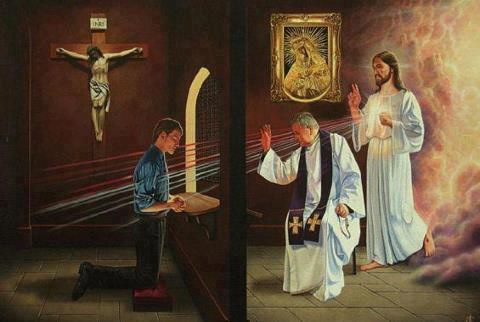
In the post earlier today, I published the first part of a brochure on Confession that can be found at the Shrine (copyright information can be found in that post.)   In that post, a lot of valuable information was presented that can help us in our preparation for the Sacrament of Confession.   In this post, we will, again using the words from that brochure, describe how we can celebrate the Sacrament of Confession. once we have prepared.  If we have prepared well, it will be a good one!

Mortal Sins Must Be Confessed

You are only obligated to confess mortal sins, although confession of venial sins is very helpful in receiving the grace to avoid sin in the future and for advancing in holiness.

For a sin to be mortal, three conditions must be met (in bold): “Mortal sin is sin whose object is grave matter and which is also committed with full knowledge and deliberate consent.” (CCC 1857)

Steps to a Good Confession

1. Examine your conscience.

2. Be repentant of your sins.

3. Confess your sins to the priest in number and kind, being sure to confess all mortal sins.

4. Make an act of contrition, receive absolution from the priest, and resolve to sin no more.

5. Do the penance the priest gives you.

How to Go to Confession

• Begin with the Sign of the Cross.

• Then say, “Forgive me, Father, for I have sinned. It has been ______ days/weeks/ months/years since my last confession.”

• Tell the priest your sins and how many times you committed each (to the best of your memory), beginning with any mortal sins and any sins you are particularly struggling with.

• The priest will give you some advice and assign you a penance.

• You then make the Act of Contrition.

• The priest will give you absolution and then dismiss you.

Act of Contrition

 O my God, I am heartily sorry for having offended you, and I detest all of my sins, because I dread the loss of heaven and the pains of hell, but most of all because they have offended you, my God, who are all-good and deserving of all my love. I firmly resolve with the help of your grace, to sin no more, to do penance, and to avoid the near occasions of sin. Amen.


 (The rest of this post are my words.)


Confession is a beautiful experience.    I go every 4-6 weeks.  Once a month should be the goal of all Catholics.  Under no circumstances should we go more than two months without receiving it.   We simply cannot live a devout, full Christian life without frequent reception of this Sacrament.
However, even if you have not been to Confession for a long time;  6 months, a year, 6 years, or even 60 years, like the loving father in the story of the Prodigal Son,  the Lord is ready to welcome you with open and loving arms!  Any baptized Catholic can go, no matter how long it has been.  Any baptized person,  even non-Catholics, may be able to receive under certain circumstances (ask a local priest.)

Remember that a priest cannot reveal anything he has heard in the Confession under any circumstance.   If he does, he can no longer function as a priest.   And a priest has heard it all!  For these reasons, never be afraid to confess your sins to him!   

Happy Feast of Divine Mercy to all of you!


Preparing for Confession

In light of today's Feast of Divine Mercy, I thought I would share with you material from a brochure that the Shrine has outside its confessionals.  It is a wonderful tool to help one prepare to receive the Sacrament of Confession.   Sometimes when we go to Confession, it is clear what we need to confess, but sometimes it is not so clear, and guides like can be very helpful.  This is one of the most thorough, complete guides to an examination of conscience that I have encountered, and I feel it is worthwhile to share with you all.  It is copyrighted 2010 from the Archdiocese of Boston, and it is adapted from the Diocese of Fall River's "Be Reconciled to God" initiative in 2009.   (This brochure also great information on actually making a Confession, and that will be the topic of our next post.  Today we will just discuss preparing for it.  The beautiful stained glass window pictured here is from the corridor at the Shrine where the confessionals are.)

Preparing for Confession

• Find a quiet place to pray and think. • Ask the Holy Spirit in prayer to help you remember your sins. • Use the questions below as a guide. • Remember to include sins of omission—that is, things you should have done but did not.

Examination of Conscience

First, consider how well you have kept the Ten Commandments.

 First Commandment “I am the lord your God. … You shall have no other gods before me.” – Exodus 20:2-3

• Do I put other things, activities, or people before God? • Have I spent time with God each day in prayer? • Do I accept all of God’s teaching or just the parts I find convenient? • Have I practiced or engaged in occult practices, such as consulting horoscopes, tarot cards, fortune telling, or “Ouija” boards? • Have I denied my faith in any ways? • Have I ever received Holy Communion in the state of mortal sin?

Second Commandment “You shall not take the name of the lord your God in vain.” – Exodus 20:7

• Do I always show respect and reverence for God’s name? • Have I used God’s name as a curse, out of anger, or in a careless way? • Have I irreverently spoken about God or about any sacred person, place, or thing? • Have I done my best to fulfill any promises in which I invoked God’s name (oaths)?

Third Commandment “Remember the Sabbath day, to keep it holy.” – Exodus 20:8

• Have I deliberately missed Mass on a Sunday or holy day of obligation without just cause (for example, a serious illness)? • Do I actively and fully participate at Mass? • Have I carelessly arrived late or left early from Mass without a serious reason? • Have I kept the Eucharistic fast before Mass (i.e., no food or drink—except water—for one hour before receiving Holy Communion)?

Fourth Commandment “Honor your father and your mother.” – Exodus 20:12

• Have I failed to show love and respect to my parents? • Have a lied to, deceived, or disobeyed them? • Have I gotten angry, talked back, or used profanity at them? • Have I failed to be grateful for the sacrifices they have made for my family? • Have I fulfilled all the duties and responsibilities I have toward my parents and family? • Have I been critical of them to others? • Do I respect and obey others who have a legitimate role of authority in my life?

 Fifth Commandment “You shall not kill.” – Exodus 20:13

• Have I killed or harmed someone physically, mentally, or verbally? • Am I harming myself (and setting a bad example for others) by taking drugs or abusing alcohol? • Have I harmed someone through insults or bullying? • Have I mutilated or harmed my body? • Have I tried to commit suicide? • Did I have an abortion? • Have I encouraged, helped, or in any way participated in someone else’s abortion? • Have I easily lost my temper or shown anger toward someone? • Have I fostered a grudge or failed to forgive another?

Sixth and Ninth Commandments “You shall not commit adultery.” – Exodus 20:14

“You shall not covet your neighbor’s wife.” – Exodus 20:17

• Do I treat the body as a temple of the Holy Spirit, respecting the sexual dignity of others and myself? • Have I willfully engaged in impure thoughts or desires? • Have I looked at pornographic images or videos? • Have I watched impure TV shows or movies? • Have I committed impure acts by myself (i.e., committed the sin of masturbation)? • Have I committed impure acts with another or led others to commit impure acts? • Have I dressed or acted immodestly, possibly leading others to sin? • Have I practiced any form of contraception?

Seventh and Tenth Commandments “You shall not steal.” – Exodus 20:15

“You shall not covet your neighbor’s house.” – Exodus 20:17

• Have I stolen anything or helped or encouraged anyone else to steal? • If I have stolen something, have I made restitution to its owner? • Have I damaged another’s property without acknowledging and making restitution? • Have I been greedy or overly attached to the things of the world? • Have I carelessly wasted time at home, at school, or at work? • Have I failed to help others—especially the poor—by neglecting to share what I have? • Have I honored my debts?

Eighth Commandment “You shall not bear false witness against your neighbor.” – Exodus 20:16

• Have I lied? • Have I revealed the faults of others without just cause? • Have I gossiped about others? • Have I failed to honor a confidence or secret entrusted to me? • Have I damaged another’s reputation through lies or accusations? • Have I failed to defend someone’s good name?

The Seven Deadly Sins and the Opposite Virtues

Am I guilty of any of the following sins? Consider how you can grow in the opposing virtue. (See CCC 1866.)

1. Pride, Humility

2. Greed, Generosity

3. Lust, Chastity

4. Anger, Patience (Meekness) 

5. Gluttony, Temperance

6. Envy, Kindness

7. Sloth, Diligence (Persistence)

The Spiritual Works of Mercy

By considering the Spiritual and Corporal Works of Mercy we can remember times we may have committed sins of omission. We can also be reminded of ways in which we can grow in holiness.

Have I neglected to do the following when circumstances obliged me?

1. Counsel the doubtful.

2. Instruct the ignorant.

3. Admonish sinners.

4. Comfort the sorrowful.

5. Bear wrongs patiently.

6. Forgive all injuries.

7. Pray for the living and the dead.


The Corporal Works of Mercy

Have I neglected to do the following when circumstances obliged me?

1. Feed the hungry.

2. Give drink to the thirsty.

3. Clothe the naked.

4. Shelter the homeless.

5. Visit the sick.

6. Visit the imprisoned.

7. Bury the dead.


Thursday, April 20, 2017

Be fruitful and multiply, Part Six


At the Easter Vigil this past weekend, the very first reading was Chapter 1 of Genesis, the creation story, which has served as the leading inspirational Scripture for this series of posts.   It is appropriate to begin, this, our final reflection in this series, with a quote from that reading:

Then God said:
"Let us make man in our image, after our likeness.
Let them have dominion over the fish of the sea,
the birds of the air, and the cattle,
and over all the wild animals
and all the creatures that crawl on the ground."
God created man in his image;
in the image of God he created him;
male and female he created them.
God blessed them, saying:
"Be fertile and multiply;
fill the earth and subdue it.
Have dominion over the fish of the sea, the birds of the air,
and all the living things that move on the earth."
God also said:
"See, I give you every seed-bearing plant all over the earth
and every tree that has seed-bearing fruit on it to be your food;
and to all the animals of the land, all the birds of the air,
and all the living creatures that crawl on the ground,
I give all the green plants for food."
And so it happened.
God looked at everything he had made, and he found it very good.
Evening came, and morning followed—the sixth day.

How appropriate that we begin the most solemn ceremony of the entire liturgical year with this reading.   We begin our celebration of Easter by recalling this great act of God, in creating the world, creating nature, and creating man and woman as the pinnacle of that creation, and then immediately telling man to “be fertile and multiply”.   This command did not come years, months, days, or even hours after we were created. No, it came moments, or even seconds, after our creation. “Be fertile and multiply”. 

This command has been with us since the beginning of time.   It will be with us until the end of time. There is no time in our history where that command has not been imposed on us by God.  This command came before the Ten Commandments.  It came before the Beatitudes, and other teachings of Jesus.  Without this command, no other command of God makes sense.  Without this command, there can be no life.  Without life, there can be no other good.   If we ignore this command, we cannot do much else.

All signs, at least here in this country and in many other of the traditional industrialized, or world powers, unfortunately, sadly show that we are not doing this.  We are shrinking as a population.  We are being told reason upon reason why we should not be growing.   There is not enough food, they say.   The environment cannot sustain us, they say.   There is not enough room for everybody, they say.   Overpopulation is a drain on the economy, they say.

Well, here are some facts, courtesy of the website overpopulationisamyth.com

1)      Every family in the world could have a house and a yard and fit in the state of Texas.

2)      The fact that so many people are delaying having children or not having children at all is causing many countries birthrate to fall below replacement rate.  This causes economies to collapse or at least be terribly strained when there are not enough working people to support the elderly of the population.

3)      There is enough food in the world for everyone to live a healthy life.   Modern farming methods allow us to grow food in places we could never before, like parts of Africa.   Lack of infrastructure, and war, contribute much more to the problem of famine in some areas than does overpopulation.

4)      Poverty is not caused by overpopulation.  Communities allow us to divide tasks, share resources, and come up with creative solutions to problems.   Our average standard of living has grown as the population has grown.   The percentage of poor people goes down as the population has grown.   People are the solution to poverty, not the cause.

5)      Cities are overcrowded, but that does not mean the world is overpopulated.   They are not the same, and often we confuse the too, especially since this is the experience of many of us who live in densely populated areas.  

I would add another point here, and it has to do specifically with life in the Church.  So often when we discuss problems in the Church we hear things like people are not going to Mass and/or Confession regularly, we do not have prayer lives, we give a less than acceptable percentage of our income to the Church, and other reasons why churches are a lot emptier and more lifeless these days than they were, and these are valid reasons why things are as they are.   However, we often do not consider a more basic reason: There are not as many people out there.   There are not enough people to work, and give to the Church.  There are not enough people to fill the churches.   There are not as many opportunities to evangelize.   Now, there are indeed spiritual elements to the decline in the Church.   If more people were practicing their Faith, then yes, the churches would be fuller.  If we evangelized better than we are, more people would be joining the Church.  All this is true.   However, let us not easily dismiss the fact that there are fewer of us than there were before, and this is contributing at least somewhat to the problem.

I believe as a nation we need to turn again to God, in many areas of our life.   We need to make a commitment to live all his Commands.  We need to have a holy fear of God.  We need to love him with all our hearts and love our neighbor as ourselves.   We need to honor our mother and father, keep holy the Sabbath, not commit adultery, not covet one another, not steal, and not cheat.  We need to be prudent, just, strong, and temperate.   We need to be peaceful, meek and merciful, pure and righteous before God.   

However, before all this, we need to exist in the first place.  We need to be alive.  We need to be given the chance to live, to come into this beautiful world that God created that is so beautifully described in the Creation story.

So when we turn back to God, we need to give him our whole selves.  This includes all our being, including our sexuality.   We cannot close any part of us to God, and that includes our most private body parts.   We have to develop what Saint John Paul II called a “culture of life”.   This means we must respect all human life from conception until natural death, and we must provide the necessary means to support that life.    We need to support people having children, and we must consider it ourselves if we can.   And on the other end of the life spectrum, we must not seek to kill our elderly, but rather, we must develop a society where there are indeed enough of us to support them so they can live fruitful, peaceful lives in old age.

Controlling or limiting the population is not the answer to our problems.  It is against the will of God.   Not only will it cause issues as we have discussed here, and are available to read about elsewhere, but it may very well cause us eternal issues in the next life when we stand before the judgment seat of God. Let us never forget those beautiful words from Genesis, “Be fruitful and multiply”.   If we do, we can be assured that when our times is up, and we are standing before the judgment seat of almighty God, we will hear another set of beautiful words:

 “Well done good and faithful servant, enter into the joy of your Master’s house.” (Matthew 25:23).


Joseph, glory of home life, pray for us.

He made him the lord of his household.   And prince over all his possessions.